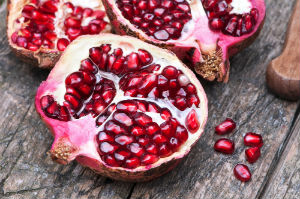
Organic pomegranate seeds or refreshing pomegranate juice is a delicious, refreshing snack! This slightly peculiar fruit has been thought to hold legendary powers for centuries. Persians believe Eve actually ate a pomegranate when she plucked from the tree of knowledge in the Garden of Eden, not an apple. Ancient Egyptians buried their dead with pomegranates because they believed it offered eternal life. This fruit is also featured in mythology and tradition as a symbol of good tidings. Greeks break open a pomegranate at wedding celebrations and the Chinese eat candied pomegranate seeds for good luck.

The Health Benefits of Pomegranates
Length: 4 minutes
Pomegranate Research
Researchers are discovering the truth surrounding the pomegranate's powers, proving why this exotic fruit has claimed such a fabled place in cultures throughout the ages. Scientists conducting research on the many health benefits of pomegranates have made some incredible discoveries.
First, organic pomegranates are full of antioxidants. These are compounds and enzymes known for keeping low-density lipoprotein (LDL) or "bad" cholesterol from oxidizing and causing atherosclerosis, or hardening of the arteries [1]. Organic pomegranate seeds act a lot like aspirin, keeping blood platelets from sticking together and forming dangerous blood clots. [2]
Punicalagins is a compound found in pomegranates and is responsible for the strong antioxidant activity this fruit carries. A study found that punicalagins promotes a healthy coronary function while counteracting vascular inflammation and oxidative damage. [3]
Antioxidants also buffer the effects of free radical damage to your cells caused by oxidation. Free radicals are produced by functions within the body and elements outside the body, such as radiation from the sun. You can't stop free radical occurrence and oxidation but you can consume foods that help neutralize their potential damage.
Research also shows that eating organic pomegranate seeds and drinking pomegranate juice can increase oxygen levels to the heart [4].
Other studies reveal that, over time, organic pomegranates might help combat erectile dysfunction [5]. This super fruit might also reduce the redness of arthritis by slowing the enzymatic activity that breaks down cartilage.
How to Eat an Organic Pomegranate
The pomegranate is an intricate fruit that contains a maze of seeds inside an encapsulation of bark-like, inedible flesh. It may initially look daunting but there is an easy way to get to all those nutritious, sweet and juicy seeds.
- Cut off the crown (you'll see it) and discard in your compost pile.
- Score and slice the rind all around, but don't cut the rind all the way through.
- Soak the pomegranate face down in cold water for about ten minutes.
- While the pomegranate is still in the bowl of water, break apart the scored rinds, and remove the seeds from the flesh (the seeds will sink to the bottom of your bowl).
- Remove the rind and membrane from the bowl with a sieve or spoon.
- Drain the seeds with a colander and pat dry with a paper towel.
To get the most out of an organic pomegranate, eat the seeds while they're at their freshest and juiciest. This is when their therapeutic powers are at their peak!
Some people suck the juice out and spit out the seed. This is a personal choice but most of the beneficial fiber comes from the seed so it is beneficial to eat it and a waste to ignore it. Organic pomegranate seeds are bursting with a delicious, pleasant, slightly acidic flavor that has all the sweetness of cranberries without the tartness.
I suggest sprinkling the seeds on a green salad or a fruit salad. You'll be surprised at the awesome extra taste sensation this provides. You can add them to any recipe that calls for fruit or seeds, too. Pomegranates are often used in Middle Eastern dishes and make a great cranberry-style sauce.
Organic pomegranate seeds are also perfectly delicious eaten all by themselves.
Health Benefits of Organic Pomegranates
Packed with antioxidants equal to those in green tea and red wine, and especially loaded with vitamin C and potassium, pomegranates are believed to help:
- Lower Risk of Heart Disease [6]
- Lower Risk of Cancer, Especially Prostate and Breast [7]
- Lessen Symptoms of Diarrhea [8]
- Reduce Cholesterol [9]
- Control Your Weight [10]
- Fight Cell Damage [11]
Pomegranates are one of the few fruits where the juice is just as beneficial as the fruit or seeds. The peel, which you can't eat, contains the most antioxidants, and they are released in abundance when the fruit is squeezed for juicing.
Note: Eating pomegranates might interfere with certain medications in the same way that grapefruit juice does. Be sure to ask your doctor or pharmacist about drug interactions.
Pomegranate's wine-red juice will stain your fingers, clothes, and countertops! Be careful with these.
References (11)
- Filomena de Nigris, sharon Williams-Ignarro, Vincenzo Sica, Lilach O. Lerman, Fancesco P. D'Armiento, Russel E. Byrns, Amelia Casamassimi, Daniela Carpentiero, Concetta Schiano, Daigo Sumi, Carmela Fiorito, Louis J. Ignarro, Claudio Napoli. Effects of a pomegranate fruit extract rich in punicalagin on oxidation-sensitive genes and eNOS activity at sites of perturbed shear stress and atherogenesis. European Society of Cardiology. 2006 August 25. (2007) 73 (2): 414-423. doi: 10.1016/j.cardiores.2006.08.021.
- Michael Aviram, Mira Rosenblat, Diana Gaitini, Samy Nitecki, Aaron Hoffman, Leslie Dornfeld, Nina Volkova, Dita Presser, Judith Attias, Harley Liker, Tony Hayek. Pomegranate juice consumption for 3 years by patients with carotid artery stenosis reduces common carotid intima-media thickness, blood pressure and LDL oxidation. Clinical Nutrition. 2004 June. vol. 23 issue 3, pages 423-433.
- Vilahur G, Padro T, Casani L, et al. Polyphenol-enriched diet prevents coronary endothelial dysfunction by activating the Akt/eNOS pathway. Rev Esp Cardiol (Engl Ed). 2015 Mar;68(3):216-25. doi: 10.1016/j.rec.2014.04.021.
- Aviram M, Dornfeld L, Kaplan M, Coleman R, Gaitini D, Nitecki S, Hofman A, Rosenblat M, Volkova N, Presser D, Attias J, Hayek T, Fuhrman B. Pomegranate juice flavonoids inhibit low-density lipoprotein oxidation and cardiovascular diseases: studies in atherosclerotic mice and in humans. Drugs Exp Clin Res. 2002;28(2-3):49-62. Review.
- C P Forest, H Padma-Nathan, H R Liker. Efficacy and safety of pomegranate juice on improvement of erectile dysfunction in male patients with mild to moderate erectile dysfunction: a randomized, placebo-controlled, double-blind, crossover study. International Journal of Impotence Research. 2007 April 26. 19, 564–567; doi:10.1038/sj.ijir.3901570.
- Sumner MD, Elliott-Eller M, Weidner G, Daubenmier JJ, Chew MH, Marlin R, Raisin CJ, Ornish D. Effects of pomegranate juice consumption on myocardial perfusion in patients with coronary heart disease. Am J Cardiol. 2005 Sep 15;96(6):810-4.
- Mee Young Hong, Navindra P. Seeram, David Heber. Pomegranate polyphenols down-regulate expression of androgen-synthesizing genes in human prostate cancer cells over expressing the androgen receptor. The Journal of Nutritional Biochemistry. 2008 November 8. vol. 19 issue 12, pages 848-855.
- J.L.S. Goncalves, R.C. Lopes, D.B. Oliveira, S.S. Costa, M.M.F.S. Miranda, M.T.V. Romanos, N.S.O. Santoz, M.D. Wigg. In vitro anti-rotavirus activity of some medicinal plants used in Brazil against diarrhea. Journal of Ethnopharmacology. 2005 July 14. vol. 99 issue 3, pages 403-407.
- Esmaillzadeh A, Tahbaz F, Gaieni I, Alavi-Majd H, Azadbakht L. Cholesterol-lowering effect of concentrated pomegranate juice consumption in type II diabetic patients with hyperlipidemia. Int J Vitam Nutr Res. 2006 May;76(3):147-51.
- David Heber, Navindra P. Seeram, Holly Wyatt, Susanne M. Henning, Yanjun Zhang, Lorraine G. Ogden, Mark Dreher, James O. Hill. Safety and Antioxidant Activity of a Pomegranate Ellagitannin-Enriched Polyphenol Dietary Supplement in Overweight Individuals with Increased Waist Size. Journal of Agricultural and Food Chemistry. 2007 October 30. 55 (24), pp 10050–10054 DOI: 10.1021/jf071689v.
- Sarmad Hanifa, Uzma Shamima, M.F. Ullaha, Asfar S. Azmib, Showket H. Bhatc, S.M. Hadia. The anthocyanidin delphinidin mobilizes endogenous copper ions from human lymphocytes leading to oxidative degradation of cellular DNA. Toxicology. 2008 July 10. vol. 249 issue 1, pages 19-25.
†Results may vary. Information and statements made are for education purposes and are not intended to replace the advice of your doctor. If you have a severe medical condition or health concern, see your physician.